
Federal Reserve Holds Rates Despite Growing Differences Among Policymakers
On July 29, the U.S. Federal Reserve left its benchmark interest rate unchanged at 3.50%–3.75%. The decision, approved by a 9–3 vote of the Federal Open Market Committee (FOMC), marked a notable shift from the unanimous decision reached in June, with three members favouring a 25-basis-point increase. The split decision signals a modest divergence among policymakers over the appropriate path for interest rates, even as the Committee maintained that current policy remains maintained. Despite elevated uncertainty and persistent inflationary pressures, the U.S. economy continues to demonstrate resilience, supported by steady economic growth and a labour market that remains broadly balanced. At the same time, uncertainty surrounding global trade dynamics and geopolitical developments continues to present risks to the economic outlook.
Although the decision to maintain the federal funds rate was widely expected, the rationale behind the decision remains important. The Federal Reserve's assessment of the U.S. economy was largely unchanged from its previous meeting, reflecting policymakers' view that current monetary policy remains appropriately restrictive while they evaluate whether recent progress on inflation will prove sustainable. Economic activity continues to expand at a solid pace, supported by strong productivity growth and business investment, while labour market conditions remain broadly stable with job gains keeping pace with workforce growth. The Committee also reiterated that inflation remains elevated relative to its 2% target and emphasized that future policy decisions will continue to be guided by incoming economic data and the evolving balance of risks.
In June, U.S. consumer prices increased 3.5% compared to a year earlier, down from 4.2% in May, while core inflation eased to 2.6%. Although inflationary pressures have moderated, the pace of disinflation remains uneven across the economy. Energy prices continue to be a key source of volatility, reflecting ongoing geopolitical tensions and supply disruptions, while shelter, food, and medical care services remain important contributors to elevated consumer prices. Despite encouraging progress in recent months, inflation remains above the Federal Reserve's 2% objective, leading policymakers to maintain a cautious stance as they assess whether improving inflation trends will be sustained over time.
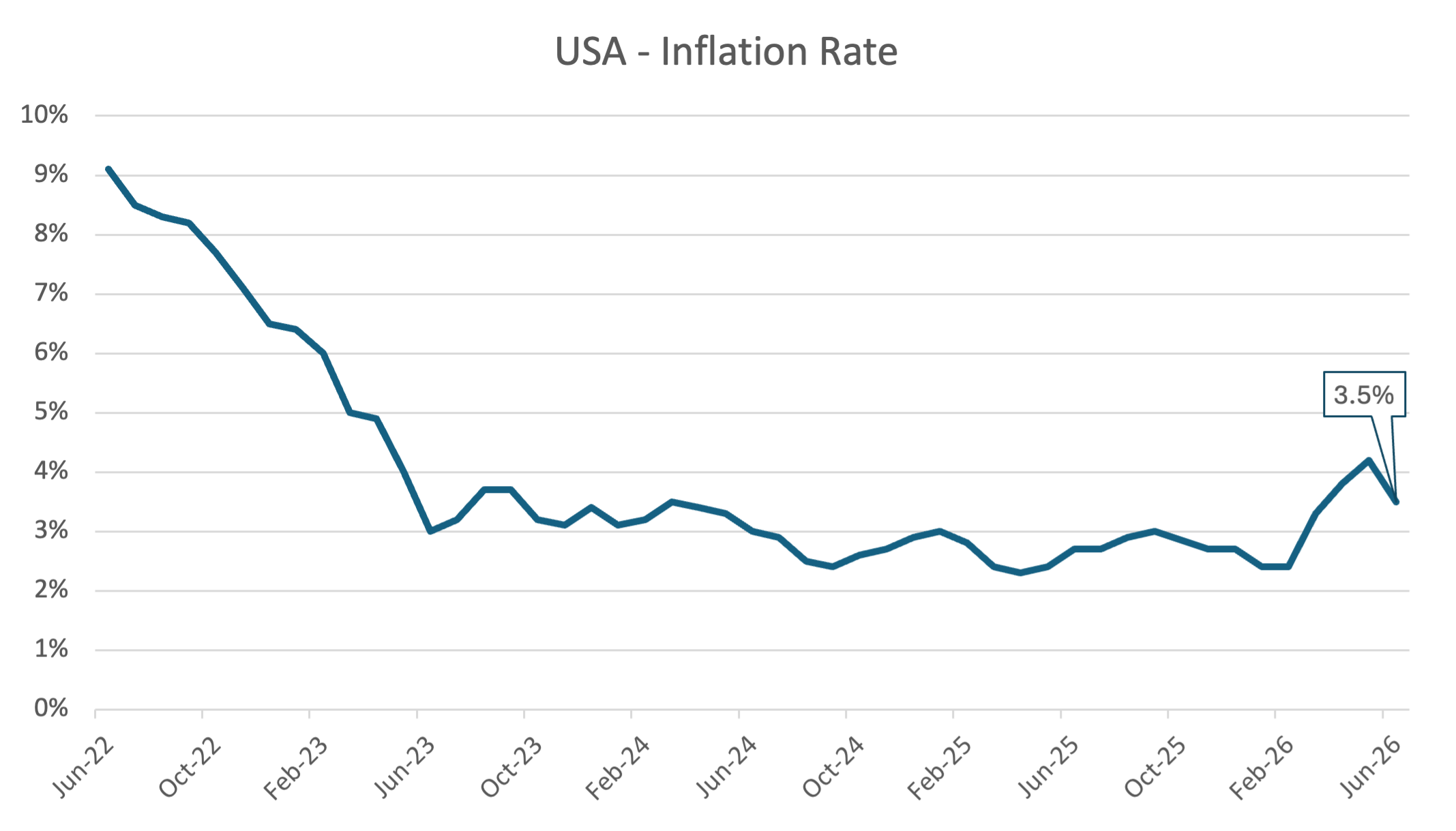
Source: U.S. Bureau of Labor Statistics - Consumer Price Index (CPI), June 2022 to June 2026
The U.S. economy has remained resilient despite a prolonged period of restrictive monetary policy. Strong business investment, productivity growth, and consumer spending have continued to support economic activity, offsetting the impact of higher borrowing costs. At the same time, elevated interest rates have tempered activity in interest-sensitive sectors, particularly housing and other rate-dependent areas of the economy, demonstrating that monetary policy continues to weigh on portions of the economy even as broader growth remains solid. This combination of resilient economic activity and above-target inflation has allowed the Federal Reserve to maintain its current policy stance while assessing the cumulative effects of higher interest rates on future growth and inflation.
Labour market conditions in the United States remain broadly stable, supporting the Federal Reserve's cautious approach to monetary policy. The unemployment rate has remained relatively low at approximately 4.2%–4.3%, while job gains have continued to keep pace with workforce growth. Although employment growth has moderated from the exceptionally strong pace seen in the years immediately following the pandemic, labour demand has largely adjusted through slower hiring rather than widespread layoffs. Wage growth has remained steady, supporting household incomes and consumer spending, although labour force participation has shown some signs of softening. Overall, labour market conditions continue to provide little evidence of significant economic weakness, allowing policymakers to remain primarily focused on returning inflation to target.
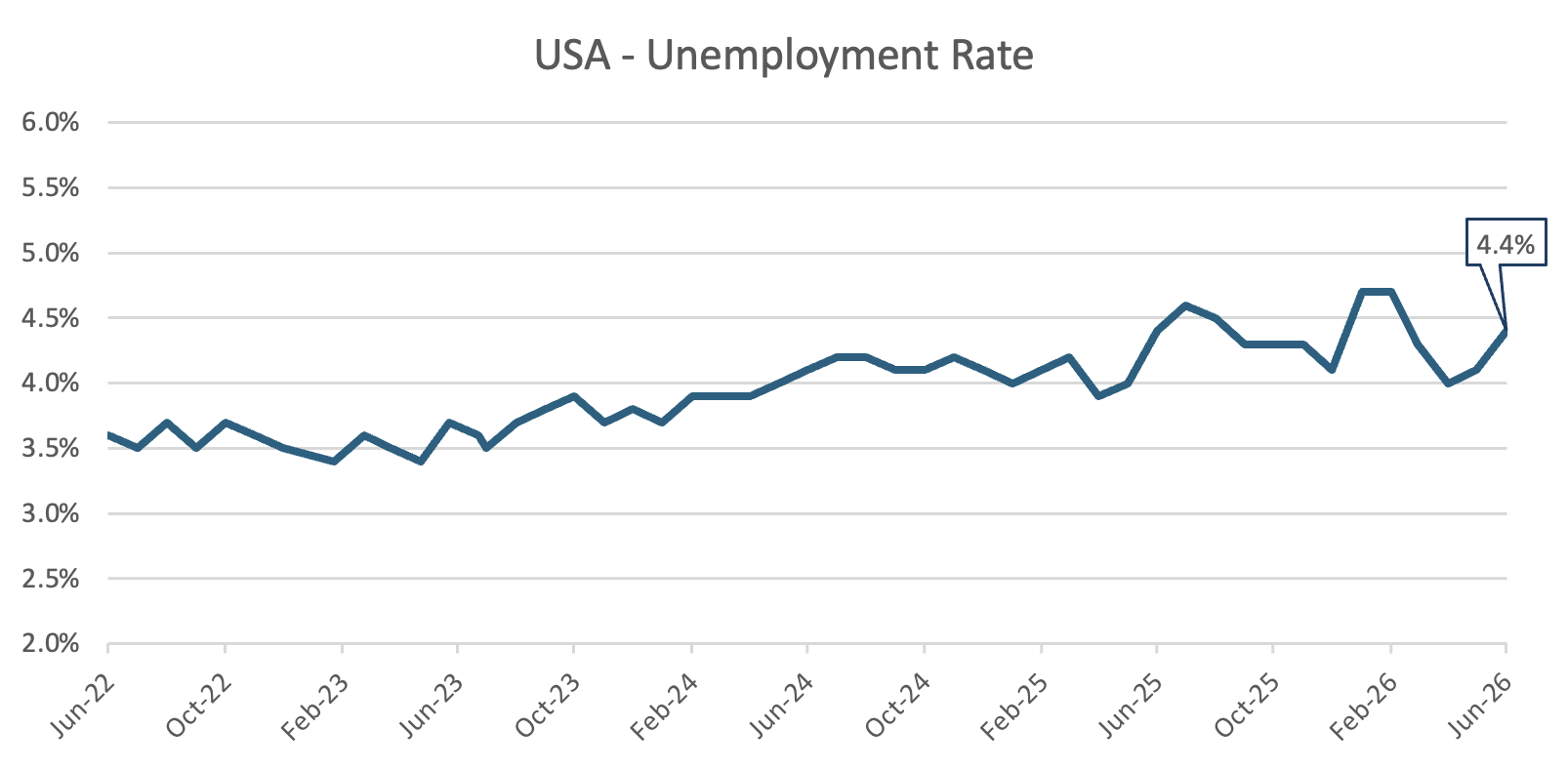
Source: U.S. Bureau of Labor Statistics - Unemployment Rate, June 2022 to June 2026
Global developments continue to represent an important source of uncertainty for the economic outlook. While energy prices have moderated from the recent highs associated with disruptions in the Middle East, policymakers continue to monitor geopolitical developments closely, as renewed volatility could place upward pressure on inflation and weigh on global economic activity. Trade-related uncertainty and evolving global supply chain dynamics also remain important considerations, influencing business investment decisions, market sentiment, and growth expectations. These external risks have the potential to complicate the Federal Reserve's progress toward price stability and will remain an important consideration as policymakers evaluate future monetary policy decisions.
Looking ahead, the Federal Reserve's policy decisions will continue to depend on the evolution of inflation and the broader economy. While recent inflation data has shown encouraging signs of moderation, price pressures remain above the Federal Reserve's 2% target, and policymakers have reiterated their commitment to restoring price stability. Economic activity continues to expand at a solid pace, providing the Federal Reserve with flexibility to maintain its current policy stance while gathering additional evidence that inflation is moving sustainably toward target. The July meeting's 9–3 vote also suggests that views within the Committee have become less unified, highlighting differing assessments of the persistence of inflationary pressures. Current market pricing suggests investors continue to expect interest rates to remain higher for longer, with Overnight Index Swap (OIS) markets assigning a 67.4% probability of a 25-basis-point rate increase at the September meeting. Expectations for additional tightening increase further into 2027, with markets pricing just over two cumulative rate increases by March 2027. These expectations will continue to evolve as new data becomes available, particularly around inflation, labour market conditions, economic growth, energy prices, and global trade developments.
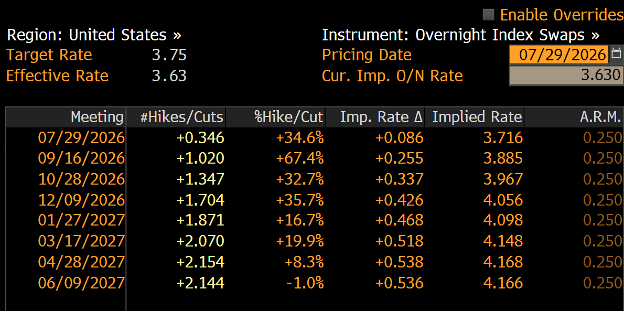
World Interest Rate Probability - Source: Bloomberg – July 29, 2026
If you would like to discuss how these developments could affect your portfolio, please contact us at 604.643.0101 or cashgroup@cgf.com.
Book a meeting today with our of our advisors: https://calendly.com/cashgroup-cgf
Market Updates
Our market commentary breaks down the latest business, financial and money news. If you’d like to receive all of our market update emails, send us an email by clicking the subscribe button. If you found this content helpful, share it widely!