
Bank of Canada Keeps Rates Unchanged as Trade Tensions Cloud the Outlook
On September 2nd, the Bank of Canada announced that it is keeping its overnight rate unchanged at 2.25%, where it has remained since October 2025. The decision comes against a noticeably different economic backdrop than earlier this year. Canadian growth strengthened significantly in the second quarter and the labour market has improved, but inflation continues to hover around 3% as the conflict in the Middle East keeps energy prices elevated. At the same time, the breakdown of trade negotiations between Canada and the United States and the introduction of new tariffs on both sides have added another source of uncertainty for businesses, consumers, and investors.
Although another rate hold was widely expected, the balance facing the Bank has shifted. Earlier this year, weak economic growth gave the Bank a strong reason to remain cautious about higher interest rates, even as energy prices pushed headline inflation upward. The latest data now point to a broader economic recovery, while the risk that higher energy and tariff-related costs eventually spread into other prices has increased. At the same time, new trade barriers could weigh on investment, employment, and exports. This leaves the Bank balancing stronger domestic economic data against two risks that can pull monetary policy in different directions: higher inflation and weaker future growth.
The clearest improvement has been in economic growth. Real GDP increased by 0.8% in the second quarter, equivalent to an annualized pace of approximately 3.3%, following very weak growth in the first quarter. The improvement was relatively broad, with household spending increasing, housing activity beginning to recover after several weak quarters, and both exports and business investment rising sharply. While elevated oil prices provided some support, based on Statistics Canada’s industry data, even excluding the entire mining, quarrying and oil and gas extraction sector, the rest of the economy would have grown at an annualized pace of approximately 2.8%. This supports the Bank’s view that the recovery was broader than the energy sector alone, although it remains too early to know whether the stronger pace of growth will be sustained.
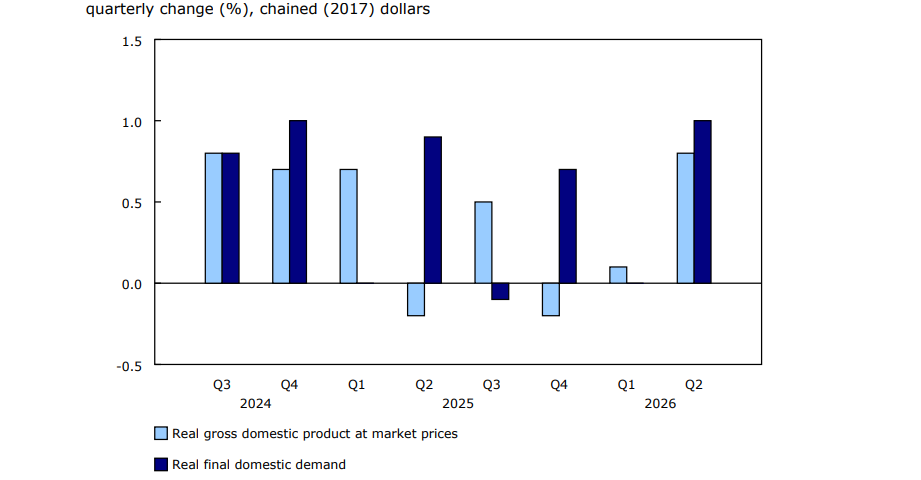
Source: Statistics Canada - Real gross domestic product and final domestic demand
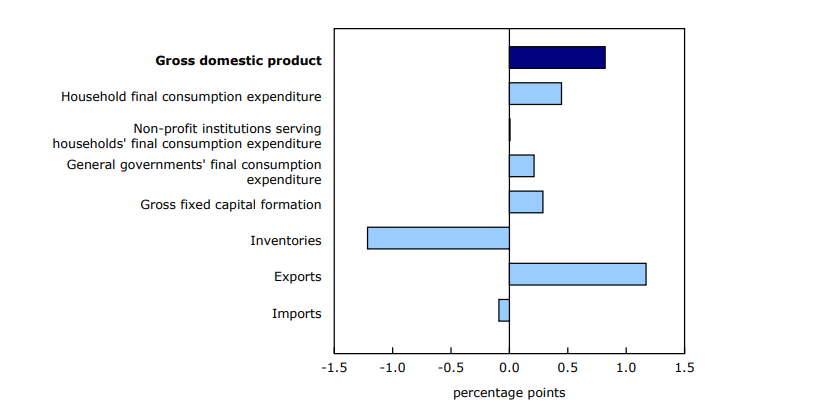
Source: Statistics Canada - Contributions to percentage change in real gross domestic product, second quarter of 2026
The labour market has also moved in a more positive direction. Employment increased by 75,000 in July and the unemployment rate declined to 6.4%, its lowest level in two years and the third consecutive monthly decrease. However, the broader picture remains more balanced than strong. The Bank continues to describe demand for labour as subdued and believes there is still excess supply in the economy. In other words, recent employment data suggest conditions are improving, but the labour market is not yet tight enough to create significant additional inflation pressure on its own.
Inflation remains the more complicated part of the picture. Canada's Consumer Price Index increased 3.0% year over year in July, up from 2.8% in June, with gasoline prices rising 25.7% from a year earlier. Excluding gasoline, however, inflation remained considerably lower at 2.2% for the third consecutive month. So far, there is therefore little evidence that higher energy prices are becoming broadly embedded across the economy. The concern is what happens if they remain elevated for longer. The Bank noted that continued disruption around the Strait of Hormuz increases the risk that higher energy and transportation costs eventually feed into other goods and services, while new tariffs and Canadian counter-tariffs could create another source of higher business costs and consumer prices.
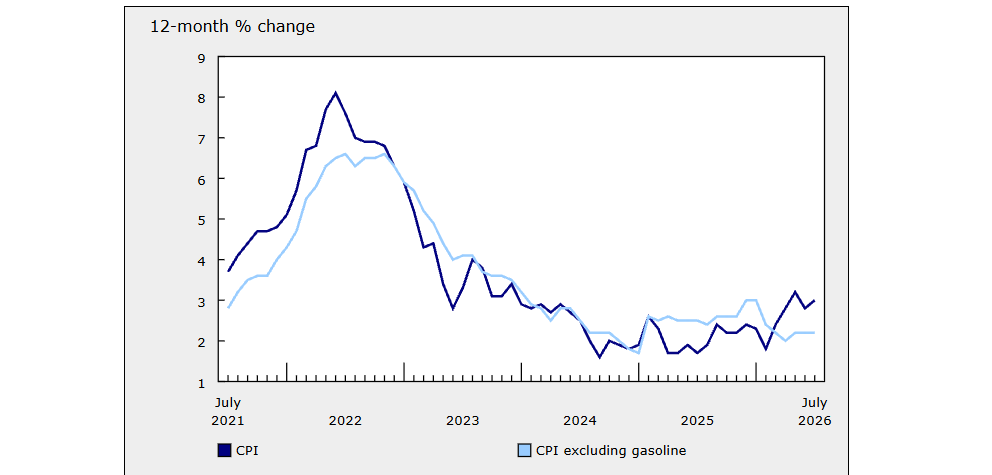
Source: Statistics Canada - The 12-month change in the Consumer Price Index (CPI) and CPI excluding gasoline
Developments in the United States add another important dimension to the Canadian outlook. US economic growth remains relatively resilient, supported by consumer spending and investment, although real GDP growth slowed to an annualized 1.5% in the second quarter from 2.1% in the first. The unemployment rate remained low at 4.1% in July, while Federal Reserve Chair Kevin Warsh recently noted that US inflation remains well above its 2% target at 3.4%. In his Jackson Hole speech, Warsh emphasized that inflation remains the more significant concern for monetary policy.
Looking ahead, Bloomberg’s World Interest Rate Probability data show that markets are not expecting rate cuts in either Canada or the United States in the near future. In Canada, however, there is still considerable uncertainty around when a rate increase could occur. Markets currently assign a 27.2% probability of a 25 basis point increase in October and 41.0% in December, with probabilities rising further into 2027 and reaching 65.7% by the April meeting. This suggests that investors increasingly see another rate increase as a possibility, but there is little conviction around whether it will happen this year or next. The US outlook is more immediate, with markets assigning a 65.2% probability of a 25 basis point increase at the Federal Reserve’s September meeting following Warsh’s recent comments. There also remains a sizeable difference between the two countries’ policy rates, with the Federal Reserve’s current target range of 3.50%–3.75% well above the Bank of Canada’s 2.25%. If US rates move higher while the Bank remains on hold, that gap could widen further and add pressure to the Canadian dollar relative to the US dollar.
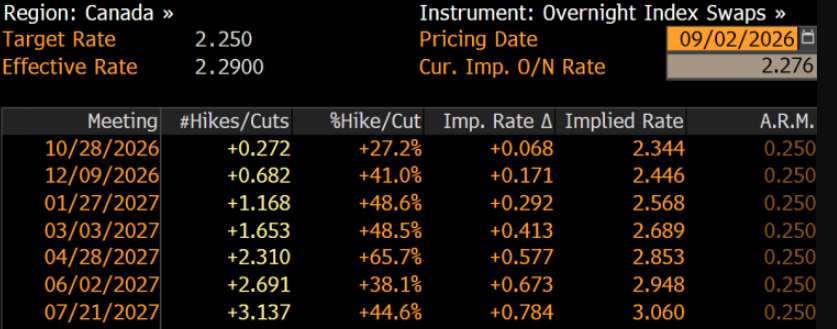
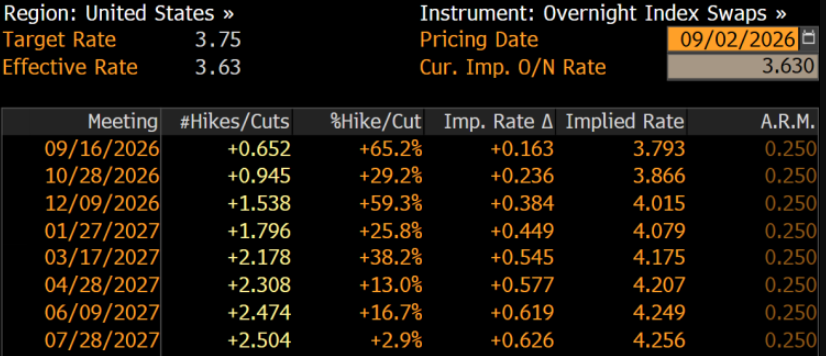
World Interest Rate Probability - Source: Bloomberg - September 2, 2026
If you would like to discuss how these developments could affect your portfolio, please contact us at 604.643.0101 or cashgroup@cgf.com.
Book a meeting today with our of our advisors: https://calendly.com/cashgroup-cgf
Market Updates
Our market commentary breaks down the latest business, financial and money news. If you’d like to receive all of our market update emails, send us an email by clicking the subscribe button. If you found this content helpful, share it widely!